
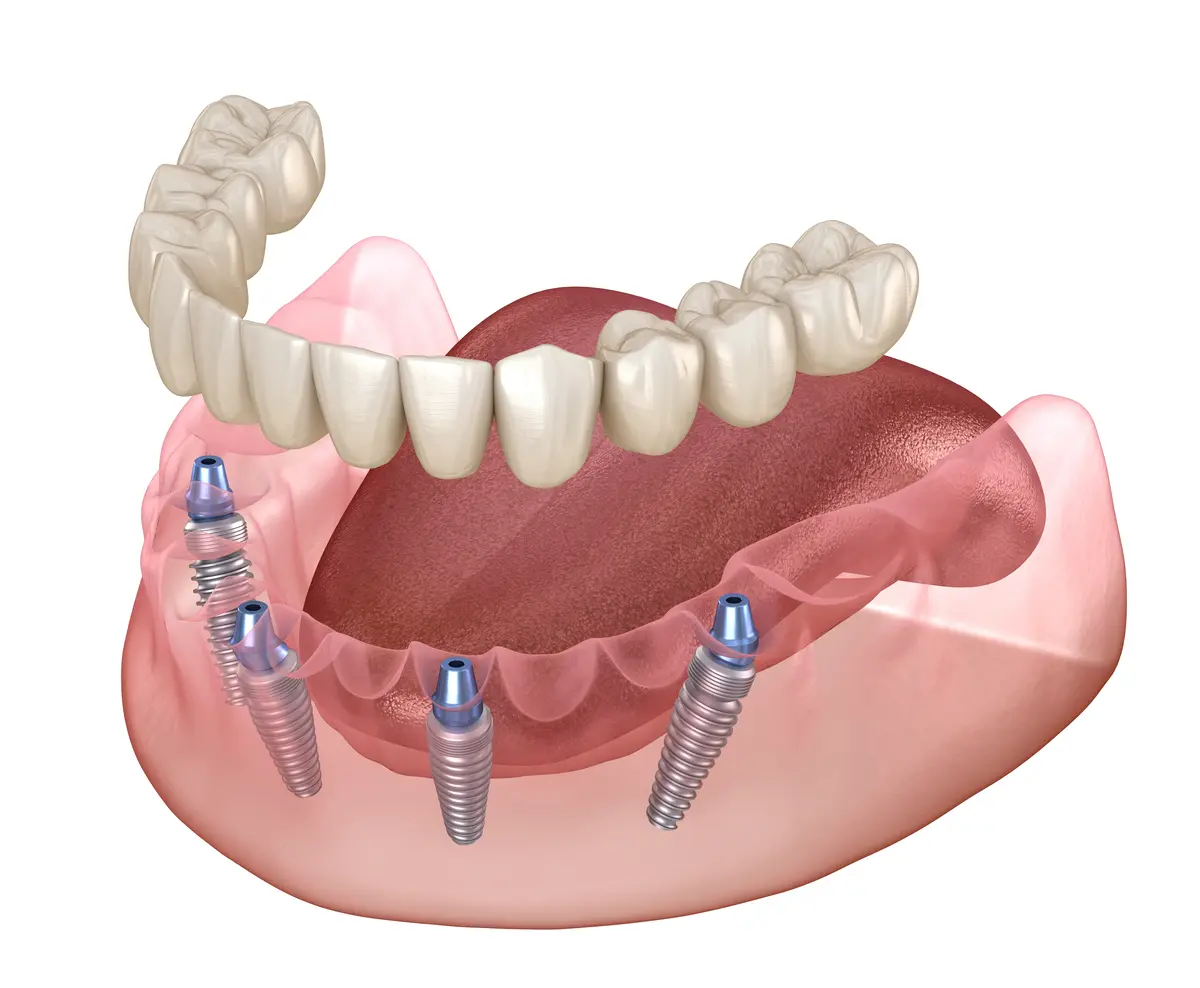
Tooth loss can affect how you chew, speak, smile, and feel in daily life. If you have lost most or all of your teeth in the upper or lower jaw, two common options are All-on-4 dental implants and full dentures.
Both can replace a full arch of missing teeth, but they work very differently. All-on-4 dental implants use four implants placed in the jawbone to support a fixed full-arch bridge. Full dentures are removable appliances that rest on the gums and are removed for cleaning.
This guide compares both options based on stability, comfort, chewing ability, bone support, maintenance, cost considerations, treatment process, and suitability.
Medical note: This article is for general patient education only and does not replace a dental consultation. A dentist should assess your suitability for implants or dentures based on your oral health, jawbone condition, medical history, and treatment goals.
Key Takeaways
- All-on-4 dental implants are fixed full arch replacements, while full dentures are removable appliances that rest on the gums.
- Full dentures usually cost less upfront, but they may require adhesives, relines, adjustments, repairs, or replacement over time.
- All-on-4 dental implants may offer stronger stability and chewing confidence, but they require surgery, proper assessment, and long-term maintenance.
- Full dentures may suit patients who prefer a non-surgical or more budget-conscious option, especially if they are not suitable for implant surgery.
- The better option depends on your jawbone condition, gum health, medical history, budget, lifestyle, and long-term goals.
Quick Comparison: All-on-4 Dental Implants vs Full Dentures
All-on-4 dental implants may suit patients who want a fixed and more stable full arch replacement, provided they are suitable for implant surgery. Full dentures may suit patients who prefer a removable, non-surgical, or lower upfront cost option.
| Factor | All-on-4 Dental Implants | Full Dentures |
| Type of replacement | Fixed implant-supported bridge | Removable full arch appliance |
| How it is supported | Anchored to implants in the jawbone | Rests on the gums |
| Surgery needed | Yes | Usually no |
| Daily removal | Not removed by the patient daily | Removed daily for cleaning |
| Stability | Usually more stable | May move or loosen |
| Chewing confidence | Usually stronger than conventional dentures | May have more food limitations |
| Bone support | Implants help stimulate the jawbone where placed | Will resorb jawbone over time |
| Upfront cost | Usually higher | Usually lower |
| Maintenance | Requires implant hygiene and dental reviews | Requires cleaning, fit checks, relines, or replacement |
| Best suited for | Patients want a fixed solution and suitable for surgery | Patients wanting a removable or non-surgical option |
The biggest difference is how the replacement teeth are retained. All-on-4 uses implant support, while full dentures depend on gum support, suction, fit, muscle control, and sometimes adhesive.
What Are All-on-4 Dental Implants and How Do They Work?
All-on-4 is a full arch tooth replacement concept where a fixed bridge is supported by dental implants placed in the jawbone. The name is commonly used because the bridge is often supported by four implants per arch, although the actual treatment plan depends on the patient’s condition and the dentist’s assessment.
A newer approach is named All on X, where the number of implants ranges from 2 to 8, depending on the conditions and outcome desired after assessment.
Dental implants are medical devices surgically implanted into the jaw to restore chewing ability or appearance, and they provide support for artificial teeth such as crowns, bridges, or dentures.
How All-on-4 dental implants work
In a typical All-on-4 treatment concept:
- The dentist assesses your gums, jawbone, bite, and medical history.
- Dental imaging or scans may be taken for treatment planning.
- Any remaining unhealthy teeth may need to be removed.
- Implants are placed into the jawbone.
- A temporary bridge may be used first in suitable cases.
- A final bridge may be fitted after healing, depending on the treatment plan.
The bridge is fixed and is not removed by the patient every day. This is one of the reasons some patients choose All-on-4 over conventional removable dentures.
Who All-on-4 dental implants may suit
All-on-4 dental implants may suit patients who:
| You May Be Suitable If You… | Why It Matters |
| Have lost most or all teeth in one arch | All-on-4 is designed for full arch replacement |
| Struggle with loose or uncomfortable dentures | Fixed implant support may improve stability |
| Want an alternative to removable dentures | The bridge is not removed daily by the patient |
| Have suitable jawbone support | Implants need adequate support for placement and healing |
| Are willing to undergo surgery | Implant placement is a surgical procedure |
| Can maintain good oral hygiene | Implant-supported bridges require careful cleaning |
| Can attend long-term reviews | Implants and prosthetic components need monitoring |
All-on-4 dental implants should only be considered after proper clinical assessment, imaging, and a discussion of risks, benefits, alternatives, costs, and maintenance.
What Can Affect Implant Suitability?
All-on-4 dental implants are not automatically suitable for everyone. Your dentist may need to assess or manage the following before recommending treatment:
| Factor | Why It Matters |
| Gum disease | Can affect the tissues supporting the implants |
| Jawbone support | Implants need enough bone for placement and healing |
| Smoking | May affect healing and long-term implant health |
| Oral hygiene | Poor plaque control can lead to inflammation around implants |
| Medical history | Conditions such as uncontrolled diabetes may affect healing |
| Bite forces | Heavy bite pressure can place stress on the bridge or implants |
| Review attendance | Regular checks help identify issues early |
A good implant plan should include the surgery, cleaning instructions, review visits, maintenance expectations and what to do if the bridge or implant components need attention.
What Are Full Dentures and How Do They Work?
Full dentures are removable appliances designed to replace all teeth in the upper jaw, lower jaw or both. They rest on the gums and are removed for cleaning.
They may be used when all teeth in an arch are missing, when remaining teeth need to be removed, or when a patient wants a non-surgical full arch replacement option.
How full dentures work
Full dentures are made to fit the shape of your gums and jaw. Depending on the case, they may rely on suction, gum support, muscle control, bite design and sometimes denture adhesive for added stability.
Unlike implant-supported bridges, full dentures are removed daily for cleaning. Patients also need time to adapt to speaking, chewing and wearing a removable appliance.
Who full dentures may suit
Full dentures may suit patients who:
| You May Prefer Full Dentures If You… | Why It Matters |
| Want a non-surgical option | Full dentures usually do not require implant surgery |
| Need a lower upfront cost option | Dentures are often more budget-conscious initially |
| Are not suitable for implant surgery | Medical or bone conditions may limit implant options |
| Want a removable appliance | Some patients prefer removable teeth |
| Need an interim solution | Dentures may be used before future implant treatment |
| Prefer a simpler treatment pathway | Depending on the case, dentures may involve fewer surgical steps |
Common limitations of full dentures
Full dentures can restore appearance and basic function, but they have limitations.
Some patients may experience:
- Movement during eating or speaking
- Difficulty chewing harder foods
- Sore spots during the adjustment period
- A bulky feeling in the mouth
- Need for denture adhesive
- Changes in fit over time
- Need for relines, repairs, or replacement
Dentures may need relining every one to two years or whenever fit changes, and the average denture lifespan is about 3 to 10 years.
This is why follow-up care matters. A denture that fitted well at the start may not remain comfortable forever because the gums and jaw can change over time.
Key Differences in Stability, Comfort, Bone Support, and Daily Use
All-on-4 dental implants and full dentures may both replace a full arch of missing teeth, but the daily experience can be very different.
| Factor | All-on-4 Dental Implants | Full Dentures |
| Stability | Fixed to implants, usually more secure | May shift, especially lower dentures |
| Comfort | Often feels less bulky once adapted | May feel bulky or loose for some patients |
| Chewing | Usually offers stronger chewing confidence | May require softer or easier-to-chew foods |
| Speech | May feel more stable during speech | May move if fit is poor |
| Bone support | Helps stimulate the jawbone in implant areas | Does not stimulate the jawbone like implants |
| Facial support | May help support bite and facial profile through fixed teeth replacement | May need adjustment as gum and jaw shape change |
| Cleaning | Requires careful brushing around the bridge and implants | Removed and cleaned outside the mouth |
| Adhesive | Usually not required | May be needed for added stability |
| Repair needs | Bridge or implant components may require maintenance | The denture base or teeth may need repair or replacement |
| Long-term care | Needs dental reviews and hygiene maintenance | Needs fit checks, relines, and replacement over time |
Stability and chewing confidence
All-on-4 dental implants are fixed to implants in the jawbone. This can make the bridge feel more secure during eating, speaking, laughing and daily activities.
Full dentures rest on the gums. A well-made denture can work well, but some patients find that dentures move, especially lower dentures. This can affect confidence when eating harder or stickier foods.
Comfort and speech
All-on-4 bridges may feel less bulky because they are fixed and do not cover the mouth in the same way as some dentures. However, patients still need time to adjust after treatment, especially during healing.
Full dentures may feel bulkier at first. Some patients need practice to adapt their speech, chewing patterns, and tongue movements. Denture adjustments may also be needed if sore spots develop.
Jawbone support and facial structure
After tooth loss, the jawbone can gradually change because natural tooth roots are no longer present. Dental implants can help stimulate the jawbone in the areas where implants are placed.
Full dentures rest on the gums and do not provide the same type of bone stimulation. However, implants do not necessarily prevent all bone changes across the entire jaw. The amount of support depends on implant placement, bone condition, bite forces, hygiene, general health and long-term maintenance.
Eating and lifestyle differences
| Daily Situation | All-on-4 Dental Implants | Full Dentures |
| Eating firmer foods | Usually more stable after healing | May be harder depending on the denture fit |
| Speaking in public | Often feels more secure | May shift if loose |
| Laughing or smiling | A fixed bridge can help you feel more confident | Some patients worry about movement |
| Cleaning after meals | Clean around the fixed bridge | Remove and rinse the denture |
| Travelling | No daily removal needed | Need denture case and cleaning routine |
| Sleeping | Usually remains fixed | Often removed at night, based on the dentist’s advice |
This is where lifestyle matters. A patient who values fixed stability may prefer All-on-4 if clinically suitable. A patient who prioritises lower upfront cost or wants to avoid surgery may still find full dentures more practical.
Treatment Process, Recovery, and Maintenance Compared
The treatment journey is another major difference between All-on-4 dental implants and full dentures.
| Stage | All-on-4 Dental Implants | Full Dentures |
| Initial assessment | Consultation, scans, oral health review, and medical history check | Consultation, oral examination, impressions or scans |
| Preparation | Extractions, gum treatment, bone assessment, or surgical planning may be needed | Extractions or healing may be needed before fitting |
| Main treatment | Implant placement surgery and a temporary bridge in suitable cases | Denture fabrication and fitting |
| Healing or adjustment | A healing period is usually required before the final bridge in many cases | Adjustment period as gums, muscles, and bite adapt |
| Final restoration | The final bridge may be fitted after healing and review | The final denture may need adjustment for comfort and fit |
| Follow-up | Implant reviews, hygiene checks, and prosthetic maintenance | Fit checks, sore spot adjustments, relines, and replacement |
Can All-on-4 be done in one day?
Some patients may be suitable for a temporary fixed bridge on the day of implant surgery. This is sometimes described as same-day teeth or teeth in a day.
However, this depends on bone quality, implant stability, bite forces, medical history, oral hygiene and the dentist’s assessment. A final bridge is usually fitted only after healing and review.
It is safer to think of All-on-4 as a staged treatment. The appointment may involve implant placement and temporary teeth in suitable cases, but the full treatment journey includes planning, surgery, healing, final bridge fabrication and maintenance.
Recovery and adjustment
All-on-4 involves surgery, so healing and aftercare are part of the process. Your dentist should explain what to expect after surgery, what foods to eat during healing, how to clean the area and when to return for review.
Full dentures usually do not involve implant surgery, but they still require an adjustment period. The gums, muscles, bite and speech pattern may need time to adapt. Some patients need several adjustments before the denture feels comfortable.
Daily maintenance comparison
| Daily Care Area | All-on-4 Dental Implants | Full Dentures |
| Cleaning | Brush around the bridge and implants carefully | Remove and clean dentures daily |
| Night routine | Usually remains fixed unless professionally removed | Usually removed for cleaning and rest |
| Gum care | Clean around implants and under the bridge as instructed | Clean gums, tongue, and denture-bearing areas |
| Professional reviews | Needed to monitor implant health and prosthesis condition | Needed to check fit, sore spots, and denture wear |
| Possible future work | Bridge, screw, or component maintenance may be needed | Relines, repairs, or replacement may be needed |
Both options require ongoing care. All-on-4 is not maintenance-free, and dentures are not a one-time appliance that stays the same forever.
Singapore-specific treatment considerations
If you are comparing these options in Singapore, practical factors matter as much as the treatment type.
| Consideration in Singapore | Why It Matters |
| Clinic assessment and imaging | Implant suitability requires proper diagnosis and treatment planning |
| Cost transparency | Ask what is included in surgery, temporary teeth, final bridge, reviews, and maintenance |
| Follow-up access | All-on-4 requires long-term maintenance and professional review |
| Eating habits | Stability may matter if you want more confidence with varied local foods |
| Medical history | Diabetes, smoking, gum disease, medications, and healing risks should be discussed |
| Long-term clinic relationship | Implant-supported solutions need consistent aftercare, not just placement |
A proper assessment at a dental clinic in Singapore can help determine whether your jawbone, gums, bite, and medical history make you more suitable for All-on-4 dental implants or full dentures.
Questions to ask a dental clinic
| Question | Why It Helps |
| Is the consultation fee separate from imaging? | Helps you compare the total assessment cost |
| Is the quote for one arch or both arches? | Prevents misunderstanding |
| Are temporary teeth included? | Important for All-on-4 treatment planning |
| What material is used for the final bridge? | Affects aesthetics, durability, and maintenance |
| How many follow-up visits are included? | Supports cost transparency |
| Who handles maintenance or repairs? | Important for long-term care |
| What happens if I am not suitable? | Helps compare dentures, staged implants, or other options |
Who Is a Better Candidate for All-on-4 Dental Implants or Full Dentures?
There is no universal answer because the better option depends on the patient. All-on-4 dental implants may be more suitable for one person, while full dentures may be more practical for another.
| You May Prefer All-On-4 If… | You May Prefer Full Dentures If… | You Need Assessment First If… |
| You want fixed teeth that do not come out daily | You want to avoid surgery | You have active gum disease |
| You struggle with loose dentures | You need a lower upfront cost option | You have limited jawbone support |
| You want stronger chewing confidence | You prefer a removable appliance | You have medical conditions affecting healing |
| You want less reliance on denture adhesive | You need an interim solution | You smoke heavily |
| You are willing to undergo surgery | You prefer a simpler treatment pathway | You have concerns about long-term maintenance |
| You can maintain good oral hygiene | Implant treatment is not suitable or preferred | You need extractions, gum treatment or further planning |
Full dentures are not automatically inferior just because implants are fixed. For some patients, dentures are safer, simpler or more realistic based on health, budget, timing or personal preference.
Likewise, All-on-4 dental implants may be worth discussing if you are frustrated with loose dentures, want a fixed solution and are willing to go through a surgical treatment pathway.
What your dentist will need to check
Before recommending either option, your dentist may assess:
- Number of missing teeth
- Condition of remaining teeth
- Jawbone volume and density
- Gum health
- Bite relationship
- Medical history
- Smoking status
- Oral hygiene habits
- Budget and long-term expectations
- Whether extractions, bone grafting or gum treatment may be needed
The final recommendation should be based on clinical findings, not only preference.
Cost and Long-Term Value: What Should You Consider?
Cost is one of the biggest reasons patients compare All-on-4 dental implants and full dentures. However, upfront cost is not the only factor to consider.
Why upfront cost is not the only comparison
Full dentures usually cost less upfront because they do not involve implant surgery, implant components, or a fixed implant-supported bridge.
All-on-4 dental implants usually have a higher upfront cost because treatment may involve:
- Consultation and imaging
- Surgical planning
- Implant placement
- Temporary teeth in suitable cases
- Final bridge fabrication
- Follow-up reviews
- Long-term implant and prosthetic maintenance
Dentures may have a lower starting cost, but they can involve future expenses such as adhesives, relines, repairs, adjustments, or replacements. Dentures may need relining every one to two years, and the average lifespan is about 3 to 7 years.
All-on-4 dental implants also require ongoing maintenance. Implant-supported teeth are not maintenance-free. Poor hygiene, missed reviews, smoking, and uncontrolled health conditions may affect long-term outcomes.
What affects the cost of All-on-4 dental implants?
| Cost Factor | Why It Matters |
| One arch or both arches | Treating both upper and lower jaws costs more |
| Number of implants | Some cases may need more than four implants |
| Extractions | Remaining unhealthy teeth may need removal |
| Bone condition | Additional procedures may be needed if support is limited |
| Temporary bridge | Some cases involve temporary fixed teeth during healing |
| Final bridge material | Materials affect cost, strength, aesthetics and maintenance |
| Imaging and planning | Scans and diagnostics support safer treatment planning |
| Follow-up care | Reviews and maintenance are part of long-term success |
A lower quoted fee may not always include scans, temporary teeth, final bridge, reviews or future maintenance. Patients should ask what is included before comparing prices.
Long-term value comparison
| Consideration | All-on-4 Dental Implants | Full Dentures |
| Upfront cost | Usually higher | Usually lower |
| Stability | Usually stronger | Depends heavily on fit and jaw changes |
| Chewing confidence | Often stronger than conventional dentures | Maybe more limited |
| Maintenance | Implant hygiene and professional reviews | Relines, adhesives, repairs, or replacement |
| Replacement cycle | Prosthetic components may need maintenance or replacement | Dentures typically need replacement over time |
| Best value for | Patients prioritising fixed stability and long-term function | Patients prioritising lower upfront cost or non-surgical care |
The better value depends on what matters most to you: fixed stability, lower upfront cost, comfort, chewing ability, surgery avoidance, maintenance expectations, or long-term function.
Cost-related questions to ask during consultation
Before deciding, ask your dentist:
- Am I suitable for All-on-4 dental implants?
- Is the quoted fee for one arch or both arches?
- Does the fee include scans, surgery, temporary teeth, final bridge, and reviews?
- Will I need extractions, bone grafting, or gum treatment first?
- What material will the final bridge or denture use?
- What is the expected treatment timeline?
- What maintenance is required after treatment?
- What happens if an implant, bridge, denture tooth, or denture base needs repair?
- How often should I return for review?
- What are the risks if I smoke, have diabetes, or have a history of gum disease?
These questions help you compare the full cost and responsibility of each option, not just the starting price.
Singapore-Specific Treatment Considerations
If you are comparing these options in Singapore, practical factors matter as much as the treatment type.
| Consideration In Singapore | Why It Matters |
| Clinic assessment and imaging | Implant suitability requires proper diagnosis and treatment planning |
| Cost transparency | Ask what is included in surgery, temporary teeth, final bridge, reviews and maintenance |
| Follow-up access | All-on-4 requires long-term maintenance and professional review |
| Eating habits | Stability may matter if you want more confidence with varied local foods |
| Medical history | Diabetes, smoking, gum disease, medications and healing risks should be discussed |
| Long-term clinic relationship | Implant-supported solutions need consistent aftercare, not just placement |
A proper assessment at a dental clinic in Singapore can help determine whether your jawbone, gums, bite and medical history make you more suitable for All-on-4 dental implants or full dentures.
Which Option Should You Choose?
All-on-4 dental implants and full dentures can both replace a full arch of missing teeth, but they are designed for different needs.
All-on-4 dental implants are fixed, implant-supported, and often chosen by patients who want stronger stability and chewing confidence. Full dentures are removable, usually more affordable upfront, and may suit patients who want or need a non-surgical option.
The right choice depends on your oral health, jawbone condition, medical history, budget, lifestyle, and expectations. A proper dental assessment can help you compare both options safely and choose the treatment that fits your condition and goals.
If you are considering all-on-4 dental implants or want to compare them with full dentures, Oxley Dental can assess your teeth, gums, jawbone, and bite before recommending a suitable treatment plan. Contact us today so we can assist you.
Frequently Asked Questions
Are All-on-4 dental implants better than full dentures?
They may be better for patients who want a fixed and stable full arch replacement, but they are not automatically better for everyone. Suitability depends on jawbone support, gum health, medical history, budget, and willingness to undergo surgery.
Full dentures may still be the better option for patients who want a removable, non-surgical, or lower upfront cost solution.
How much do All-on-4 dental implants cost in Singapore?
The cost of All-on-4 dental implants in Singapore depends on factors such as whether one or both arches are treated, how many implants are needed, whether extractions are required, the condition of the jawbone, the type of temporary teeth, the final bridge material, imaging, surgery, and follow-up care.
A consultation is needed for a personalised estimate because two patients can have very different treatment needs.
Are full dentures cheaper than All-on-4 dental implants?
Full dentures usually cost less upfront than All-on-4 dental implants because they do not involve implant surgery or a fixed implant-supported bridge.
However, patients should also consider future costs such as relines, repairs, adhesives, replacement, comfort, chewing function, and ongoing review appointments.
How long do All-on-4 dental implants last?
All-on-4 dental implants and their bridge can last for many years with proper care, but longevity varies. It depends on oral hygiene, gum health, bite forces, smoking, medical conditions, maintenance visits, and the material used for the final bridge.
Implants and prosthetic components should be reviewed regularly so problems can be managed early.
How long do full dentures last?
Dentures may need replacement or adjustment as the mouth changes over time. Cleveland Clinic notes that the average denture lifespan is about seven to 10 years with proper care and maintenance.
You may also need relines or adjustments before replacement if the denture becomes loose or uncomfortable.
Can All-on-4 be done in one day?
Some patients may be suitable for temporary fixed teeth on the day of implant surgery. However, this depends on bone quality, implant stability, bite forces, medical history, and the dentist’s assessment.
The final bridge is usually fitted only after healing and review, so patients should ask what the clinic means by same-day teeth.
Are All-on-4 dental implants removable?
All-on-4 bridges are typically fixed and are not removed by the patient daily. Your dentist can remove or maintain the prosthesis professionally when needed.
This is different from full dentures, which are removed daily for cleaning.
Do you remove All-on-4 dental implants at night?
No. All-on-4 bridges are usually fixed and are not removed by the patient at night.
You still need to clean around the bridge and implants carefully, and your dentist may remove the prosthesis professionally for maintenance when needed.
Are All-on-4 dental implants the same as implant-supported dentures?
Not always. All-on-4 usually refers to a fixed full arch bridge supported by implants. Implant-supported dentures may be removable or fixed, depending on the design.
Your dentist should explain whether the proposed option is fixed, removable, screw-retained, or retained by other components.
Can food get trapped under All-on-4 dental implants?
Yes. Food and plaque can collect around or under the bridge, so cleaning is important.
Your dentist may recommend specific tools such as interdental brushes, floss threaders, water flossers, or other cleaning aids, depending on your bridge design.
What happens if one All-on-4 implant fails?
The next step depends on the implant position, timing, bone condition, bridge design, and overall treatment plan.
Contact your dentist quickly for an assessment. Do not ignore pain, movement, swelling, or changes in how the bridge feels.
Do full dentures feel natural?
Full dentures can restore appearance and basic function, but some patients may find them bulky or less stable than implant-supported options. Fit, bite design, adjustment time, and follow-up visits all affect comfort.
Some patients adapt well to dentures, while others prefer the added stability of implant-supported options.
Can I switch from full dentures to All-on-4 dental implants later?
In some cases, yes. Your dentist will need to assess your jawbone, gums, bite, and general health to determine whether implants are suitable.
If you have worn dentures for many years, your jawbone may have changed, so imaging and clinical assessment are important before deciding.
Do All-on-4 dental implants prevent bone loss?
Dental implants can help stimulate the jawbone in the areas where they are placed. Full dentures do not stimulate the jawbone in the same way because they rest on the gums.
However, implants do not necessarily prevent all bone changes across the entire jaw. Your dentist can explain what to expect based on your bone condition and implant plan.
Is All-on-4 painful?
The procedure is performed with anaesthesia, and discomfort during healing varies by patient. Your dentist should explain pain control, healing expectations, risks, and aftercare before treatment.
If you are worried about pain, ask your dentist what to expect during surgery, the first few days after treatment, and the healing period.
Who is not suitable for All-on-4 dental implants?
Patients with uncontrolled gum disease, insufficient bone, certain medical conditions, heavy smoking habits, or poor oral hygiene may not be immediately suitable. A dentist must assess each case individually.
Some patients may become suitable after gum treatment, medical stabilisation, smoking reduction, or additional planning.
Can elderly patients get All-on-4 dental implants?
Age alone does not automatically rule out implant treatment. Suitability depends more on oral health, jawbone support, medical history, medications, healing ability, and hygiene habits.
Older patients should have their medical history reviewed carefully before implant surgery.
Can I eat normally with All-on-4 dental implants?
Many patients experience better chewing stability than with conventional dentures, but eating habits may need to be modified during healing or while using temporary teeth.
Your dentist will advise when you can gradually return to firmer foods based on your healing progress and the type of bridge used.
Are full dentures still a good option?
Yes. Full dentures can still be a practical option for patients who want a removable, non-surgical, or lower upfront cost solution.
They may also be used as an interim option before implant treatment, especially when extractions, healing, or financial planning are needed.