

Wisdom tooth pain can be confusing, especially when terms such as extraction, removal, surgical extraction, oral surgery, and wisdom tooth surgery are used interchangeably. While they all relate to removing a wisdom tooth, they can describe different levels of treatment complexity.
If you are comparing wisdom tooth extraction vs surgery, the key difference is how easily the tooth can be accessed and removed. A simple wisdom tooth extraction may be suitable when the tooth has fully erupted, is clearly visible, and can be removed without cutting the gum or removing bone.
Wisdom tooth surgery may be recommended when the tooth is impacted, partially erupted, lying horizontally, covered by gum or bone, or positioned close to important structures such as nerves or the sinus. In these cases, your dentist may need to use a more planned surgical approach to remove the tooth safely.
If you are experiencing pain, swelling, food trapping, or recurring gum discomfort around the back of your mouth, a proper dental examination and X-ray can help determine whether monitoring, simple extraction, or surgical removal may be appropriate.
Not every wisdom tooth needs to be removed. Wisdom teeth may not need removal if they are healthy, fully grown in, correctly positioned, biting properly, and easy to clean daily.
However, removal may be recommended when they cause pain, repeated infection, cysts, gum disease, widespread decay, or issues affecting nearby teeth.
Medical note: This article is for general educational purposes only and should not be taken as a diagnosis or treatment recommendation. Please consult a dentist for advice based on your oral condition, X-rays, medical history, and treatment needs.
Key Takeaways
- A simple wisdom tooth extraction may be enough when the tooth is fully erupted, visible, and easy to access. Your dentist will still need to check the tooth roots, surrounding bone, and nearby structures before confirming whether a simple extraction is suitable.
- Wisdom tooth surgery is usually considered when the tooth is impacted, partially erupted, covered by gum or bone, or positioned at a difficult angle. In these cases, the dentist may need to make an incision, remove some bone, or section the tooth for safer removal.
- Horizontal impaction, repeated infection, cysts, decay, or issues affecting the second molar may make surgical removal more appropriate. These concerns should be assessed with a dental examination and X-ray before deciding on treatment.
- X-rays are essential because symptoms alone cannot show root shape, bone coverage, nerve proximity, or tooth angulation. A wisdom tooth may look simple in the mouth, but appear more complex once the full position is reviewed.
- The right approach depends on clinical assessment, not just pain level. Some painful wisdom teeth can be removed simply, while some painless wisdom teeth may still need monitoring or surgical assessment.
Wisdom Tooth Extraction vs Surgery: The Main Difference
A wisdom tooth extraction usually refers to removing a tooth from its socket. When the wisdom tooth is fully visible and accessible, this may be done as a simple extraction.
Wisdom tooth surgery is usually more complex. It may involve opening the gum, removing bone that blocks access, sectioning the tooth into smaller pieces, or placing stitches after removal.
Wisdom tooth removal may involve surgical access when a tooth is impacted, including cutting the gum tissue and removing bone around the tooth so it can be removed safely.
| Factor | Simple Wisdom Tooth Extraction | Wisdom Tooth Surgery |
| Tooth position | Fully erupted and visible | Partially erupted, unerupted, or impacted |
| Gum incision | Usually not needed | Often needed |
| Bone removal | Usually not needed | May be needed |
| Tooth sectioning | Usually not needed | May be needed |
| Complexity | Lower | Higher |
| Recovery | Usually simpler | May involve more swelling, stitches, and aftercare |
The difference is not only about pain. A painful wisdom tooth may still be simple to extract if it has erupted properly. A painless wisdom tooth may still require surgical assessment if it is impacted, buried, or affecting the neighbouring tooth.
If you are unsure where your case falls, a dentist can assess whether wisdom tooth extraction in Singapore is suitable or whether surgical removal may be more appropriate.
When a Simple Wisdom Tooth Extraction May Be Enough
A simple extraction may be enough when the wisdom tooth has already grown fully into the mouth, and the dentist can access it safely.
This is more likely when:
- The tooth is fully erupted.
- The tooth can be gripped and loosened with dental instruments.
- It is not trapped under gum tissue or bone.
- The roots look straightforward on X-ray.
- The tooth is not positioned too close to important structures.
- The concern is limited to a visible tooth, such as decay, food trapping, gum irritation, or fracture.
For example, if a wisdom tooth has come through properly but has decay that cannot be restored, your dentist may recommend a simple extraction. If the tooth is visible and accessible, surgery may not be necessary.
That said, visible does not always mean simple. Even a wisdom tooth that has erupted may still require surgical removal if access is limited, the roots are curved, the tooth is fragile, the tooth breaks during removal, or the X-ray shows higher complexity.
This is why your dentist should not decide based only on what can be seen in the mouth. X-rays help confirm whether the roots, bone, and surrounding structures make the case simple or surgical.
When Wisdom Tooth Surgery May Be Recommended
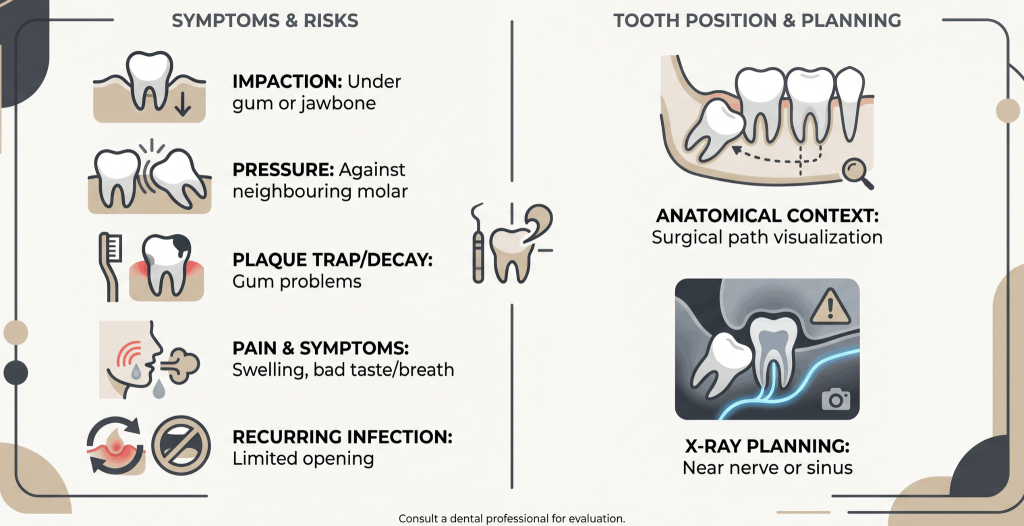
Wisdom tooth surgery is usually considered when the tooth cannot be removed predictably through a simple extraction. This often happens when the tooth is impacted, partly trapped, deeply positioned, or angled against another tooth.
Impacted wisdom tooth
An impacted wisdom tooth is a tooth that does not grow into the mouth properly. It may remain trapped under the gum or jawbone, or it may grow at an angle.
Surgical access may be recommended because the dentist needs to reach the tooth before it can be removed. In this type of case, a standard extraction may not provide enough visibility or access for removal.
Horizontal or angled impaction
Horizontal impaction is one of the clearer reasons wisdom tooth surgery may be recommended. This means the wisdom tooth is lying sideways rather than growing upright.
A horizontal wisdom tooth may press against the second molar, trap plaque, contribute to decay, or affect the gum around the neighbouring tooth. Because the tooth is not positioned normally, it may need to be exposed, sectioned, and removed in smaller pieces.
Angled impactions can also be complex. The tooth may lean forward into the molar in front, tilt backwards, or remain partly trapped under gum and bone.
Partial eruption with repeated infection
A partially erupted wisdom tooth can be difficult to clean. A flap of gum may cover part of the tooth, allowing food and bacteria to collect underneath. This can lead to recurring inflammation or infection around the area.
Patients may notice:
- Gum swelling around the back molar
- Pain when biting or chewing
- Bad taste or bad breath
- Food trapping
- Difficulty cleaning the area
- Pain that comes and goes
- Difficulty opening the mouth in more severe cases
If infection keeps returning, surgical removal may be recommended because the underlying issue is often the tooth position and gum coverage, not only the infection itself.
Gum or bone is covering the tooth
If gum tissue or bone blocks access to the tooth, a simple extraction may not be possible. The dentist or oral surgeon may need to make a gum incision, remove some bone, and section the tooth before removing it.
This is why patients considering wisdom tooth surgery in Singapore should first have the tooth position assessed with an examination and X-ray. The same wisdom tooth may look partly visible in the mouth, but still be surgically complex underneath the gum.
Concerns involving the neighbouring molar, cysts, or recurring swelling
Wisdom tooth surgery may also be recommended if the tooth is affecting the second molar, which is the tooth directly in front of it. An angled wisdom tooth can create a plaque trap, contribute to decay, or affect the gum and bone around the neighbouring tooth.
Removal may also be considered if there are cysts, recurring swelling, or other signs of disease around the impacted tooth.
Close to the nerve or sinus
Some lower wisdom teeth sit close to the inferior alveolar nerve, which provides sensation to the lower lip and chin. Some upper wisdom teeth may be close to the sinus.
This does not automatically mean the tooth cannot be removed. It means planning is more important. Your dentist may need detailed imaging and a careful discussion of risks before deciding on the most appropriate approach.
Why X-rays Matter Before Choosing Extraction or Surgery
You cannot reliably tell whether a wisdom tooth needs simple extraction or surgery based on symptoms alone.
A painful wisdom tooth may be fully erupted and simple to remove. A painless wisdom tooth may be deeply impacted and quietly affecting the tooth in front. A tooth that looks partly visible may have curved roots or sit close to a nerve.
X-rays help your dentist assess what cannot be seen during a visual examination.
| What X-rays Help Assess | Why It Matters |
| Tooth angle | Shows whether the tooth is upright, tilted, or horizontal |
| Depth | Shows whether the tooth is fully erupted or buried |
| Bone coverage | Helps determine whether surgery may be needed |
| Root shape | Curved or complex roots can make removal harder |
| Second molar contact | Shows whether the wisdom tooth is affecting the neighbouring tooth |
| Nerve or sinus proximity | Helps plan removal more carefully |
| Infection, cysts, or decay | Helps determine urgency and treatment type |
In some cases, a standard dental X-ray may be enough. In more complex cases, especially when the tooth appears close to a nerve or sinus, your dentist may recommend more detailed imaging.
The main goal is not only to remove the tooth, but to choose the safest and most appropriate method for your condition.
What to Expect During Wisdom Tooth Surgery
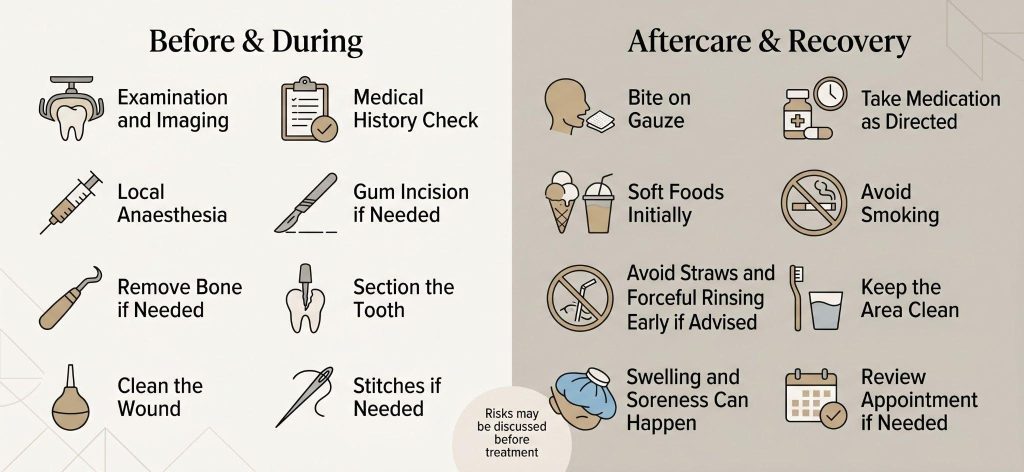
Wisdom tooth surgery is usually planned after examination and imaging. Your dentist or oral surgeon should explain the procedure, anaesthesia, risks, benefits, alternatives, and aftercare before treatment.
Before the procedure
Before surgery, your dentist may:
- Examine the wisdom tooth and the surrounding gum
- Review your X-ray or scan
- Check your medical history
- Ask about medication, allergies, and medical conditions
- Discuss anaesthesia options
- Explain possible risks and expected recovery
- Provide pre-surgery instructions
You should tell your dentist if you smoke, have diabetes, take blood thinners, are pregnant, have heart conditions, or have had previous complications with dental treatment.
During the procedure
The area is usually numbed with local anaesthesia. In selected cases, sedation may be discussed depending on the complexity of the case, patient anxiety, medical history, and clinic setup.
During surgical removal, the dentist or oral surgeon may:
- Make a small incision in the gum
- Remove the bone blocking access to the tooth
- Section the tooth into smaller pieces
- Remove the tooth carefully
- Clean the wound
- Place stitches if needed
- Ask you to bite on gauze after the procedure
After the procedure
After wisdom tooth surgery, you may have swelling, soreness, minor bleeding, and jaw stiffness. Surgical removal may involve more aftercare than a simple extraction because the gum and bone may have been involved.
Your dentist may advise you to:
- Bite on gauze as instructed
- Take prescribed medication as directed
- Eat soft foods initially
- Avoid smoking during early healing
- Avoid drinking through a straw early after surgery if advised
- Avoid forceful rinsing in the first stage of healing
- Keep the area clean as instructed
- Return for review if needed
Possible risks include dry socket, infection, bleeding, swelling, delayed healing, nerve-related numbness or tingling, sinus-related concerns for upper wisdom teeth, and effects on nearby teeth or restorations.
These risks are not mentioned to alarm you. They are part of informed consent and help you understand why proper assessment and aftercare matter.
Which Option Is Right for You?
The right option depends on the position of the tooth, how much of it has erupted, what the X-ray shows, whether there are signs of infection, and how close the tooth is to surrounding structures.
| Your Situation | More Likely Option to Discuss |
| The tooth is fully erupted and easy to access | Simple extraction |
| The tooth is visible but has straightforward roots | Simple extraction may be possible |
| The tooth is partially erupted | Surgical assessment |
| The tooth is horizontal or angled | Surgery is more likely |
| The tooth is covered by bone | Surgery is more likely |
| The tooth is close to the nerve or sinus | Careful surgical planning |
| The tooth is causing repeated infection | Surgical removal may be considered |
| The tooth is healthy, fully erupted, and easy to clean | Monitoring may be possible |
A simple extraction may be enough when the tooth is visible, accessible, and straightforward. Wisdom tooth surgery may be recommended when the tooth is impacted, covered, angled, infected, or risky to remove without surgical access.
If you need clarity, visiting a dental clinic in Singapore for an examination and X-ray can help you understand whether your case is simple, surgical, or suitable for monitoring.
Questions to ask your dentist
Before deciding, ask:
- Is my wisdom tooth fully erupted or impacted?
- Is this a simple extraction or a surgical removal?
- Is the tooth close to a nerve or sinus?
- Will the bone need to be removed?
- Will the tooth need to be sectioned?
- What type of anaesthesia will be used?
- What is the expected recovery?
- What are the risks in my specific case?
- What happens if I delay removal?
- Do all my wisdom teeth need removal, or only the problematic ones?
A good recommendation should explain not only what may need to be done, but why that method is appropriate for your specific tooth position.
Surgery Is Usually About Complexity, Not Just Pain
The difference between wisdom tooth extraction and surgery is not simply whether the tooth hurts. It depends on how the tooth is positioned, whether it has erupted, how much gum or bone covers it, whether there are signs of infection, and how close it is to nearby teeth, nerves, or sinus structures.
A simple extraction may be enough for a wisdom tooth that is fully erupted, visible, and straightforward to remove. Wisdom tooth surgery may be recommended when the tooth is impacted, horizontally positioned, partially erupted, deeply buried, repeatedly infected, or affecting the neighbouring tooth.
If you are unsure which applies to you, arrange a dental examination and X-rays so your dentist can assess the tooth position, surrounding structures, and possible treatment options.
You may book an appointment with Oxley Dental for a wisdom tooth assessment and personalised advice on whether monitoring, simple extraction, or surgical removal may be appropriate for your case.
Frequently Asked Questions
Is wisdom tooth surgery the same as extraction?
Not always. A simple extraction removes a visible tooth without surgical access. Wisdom tooth surgery may involve cutting gum tissue, removing bone, sectioning the tooth, or placing stitches.
All wisdom tooth surgery involves removing the tooth, but not all wisdom tooth extractions are surgical.
When does a wisdom tooth need surgery?
A wisdom tooth may need surgery when it is impacted, partially erupted, horizontally positioned, covered by gum or bone, repeatedly infected, affecting the second molar, or close to nerves or the sinus.
Your dentist will confirm this through examination and X-rays.
Can a wisdom tooth be pulled without surgery?
Yes. A wisdom tooth can sometimes be pulled without surgery if it is fully erupted, accessible, and can be removed safely without cutting the gum or removing bone.
Even then, X-rays are needed to check the roots and surrounding structures.
Is horizontal wisdom tooth impaction always surgical?
Horizontal impaction often requires surgical planning because the tooth is lying sideways and may be trapped under gum or bone. It may also press against the neighbouring molar.
The final decision depends on X-ray findings, tooth depth, root shape, symptoms, and nearby structures.
Is wisdom tooth surgery more painful than extraction?
The procedure itself should not be painful because the area is numbed. However, wisdom tooth surgery may involve more swelling, soreness, stitches, and aftercare than a simple extraction.
Your dentist should explain what to expect based on your specific case.
Do all impacted wisdom teeth need removal?
Not always. Some impacted wisdom teeth may be monitored if they are not causing problems and are not affecting nearby structures.
Removal may be recommended if there is pain, infection, decay, cyst formation, gum disease, or risk to the neighbouring tooth.
What happens if I delay wisdom tooth surgery?
Delaying may be acceptable in some cases, but some wisdom tooth conditions may progress if they involve repeated infection, decay, gum problems, cysts, or issues affecting the second molar.
Ask your dentist what the specific risk is in your case.
How do I know if my wisdom tooth is impacted?
You may notice pain, swelling, gum tenderness, bad taste, food trapping, or difficulty opening your mouth. However, some impacted wisdom teeth have few symptoms. An X-ray is needed to confirm whether the wisdom tooth is impacted and how it is positioned.